
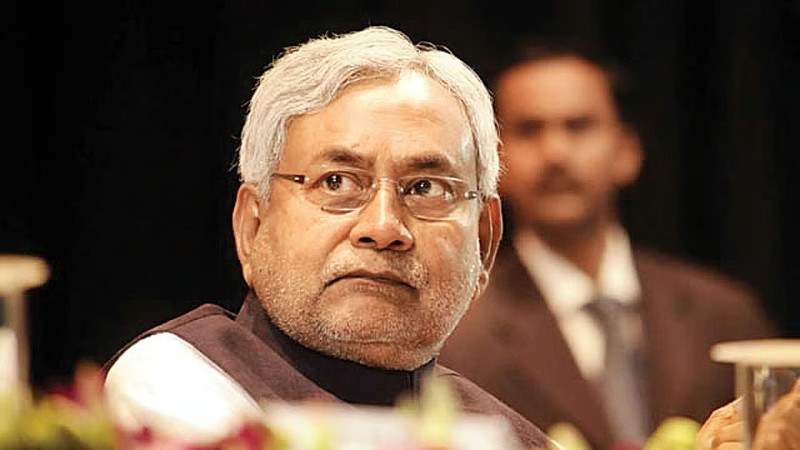
In the past 20 years, under my leadership, Bihar has progressed. Initial ten years, there was Modi’s Gujarat model of development , and here was Bihar’s model of good governance under Nitish. However, in the recent ten years, that model is not recognised by my name. This is because, in this decade I took Lalu Yadav’s party along with me twice — and besides that, the Congress as well. So there was no question of any model. But in the next four–five years, I want to once again rebuild the identity of ‘Good Administrator Nitish Babu.’
Today I took oath for the tenth time as the Chief Minister of Bihar. If I get another five years, I will be eighty years old. Recently, there has been talk in the media about my health. The BJP leaders have also mentioned it. But I will complete the next five years, unless there is any interference from the lord. I took the oath as Chief Minister for the first time in the year 2000, but after seven days, the government collapsed. After that, in 2005, I became the Chief Minister and remained in the post for eight consecutive years. That was the era of Vajpayee and Advani. Therefore, with the support of the BJP, I was able to bring Bihar, whose condition had deteriorated, back on track.
But in mid-2013, the BJP declared Narendra Modi as their prime ministerial candidate. At that time, I made my party exit the National Democratic Alliance. Many senior colleagues were not willing to do this, but I remained firm. My anger was not only personal. There were three reasons. First, under Atal Bihari Vajpayee’s leadership, the National Democratic Alliance had been formed on the basis of a common minimum programme. Later, even Lalkrishna Advani did not change that framework. Keeping aside the controversial issues was an important clause in that agreement.
And yet, the BJP chose an extremely controversial leader as the prime ministerial candidate — that was the reason for my anger. The second reason was that Bihar has a large Muslim voter population, and that community is an important support base for my party. Therefore, I felt that the party would suffer major losses. The third reason was that at that time my party had a number of seats close to a majority in the Vidhan Sabha. Therefore, even without the BJP, my government could have survived with the support of the Congress and the Left. So, I delivered a very sharp speech in the Vidhan Sabha. I expressed my sorrow, pain, and position. (You can read the Marathi transcription of that speech here)
A year later, in May 2014, the general Lok Sabha elections were held in the country. The BJP alone won so many seats that it gained an absolute majority, and Modi became the Prime Minister. In contrast, my party won only two seats in that election. This meant that the public had not accepted the stand I had taken. The decision to leave the NDA was mine alone, taken despite opposition from many leaders within the party. So, I accepted the moral responsibility for that defeat and resigned from the post of Chief Minister.
I appointed Jitanram Manjhi as Chief Minister, as he was loyal to me and came from the Dalit community. However, exactly what had happened two decades before in Maharashtra happened now in Bihar. Just as Sharad Pawar was treated by Sudhakarrao Naik, Jitanram Manjhi behaved the same way with me. Naturally, after eight or nine months, I removed him and became Chief Minister again. (You can read the editorial on this topic here)
By then, the Bihar Assembly elections were approaching. During that period, Modi’s magic was being discussed across the country. The BJP was steadily capturing state after state. Therefore, in the 2015 Bihar Assembly elections, my party alone would not have survived. Keeping Jitanram Manjhi as Chief Minister was certainly not an option. So, we fought that election together with Lalu Prasad’s party and the Congress — and we won. I became Chief Minister again, but in reality, forming an alliance with Lalu in that election was a very big defeat for me. This is because I had become Chief Minister in 2005 only after ending the fifteen-year regime of Lalu Prasad. But a long time had passed, and there was no other option.
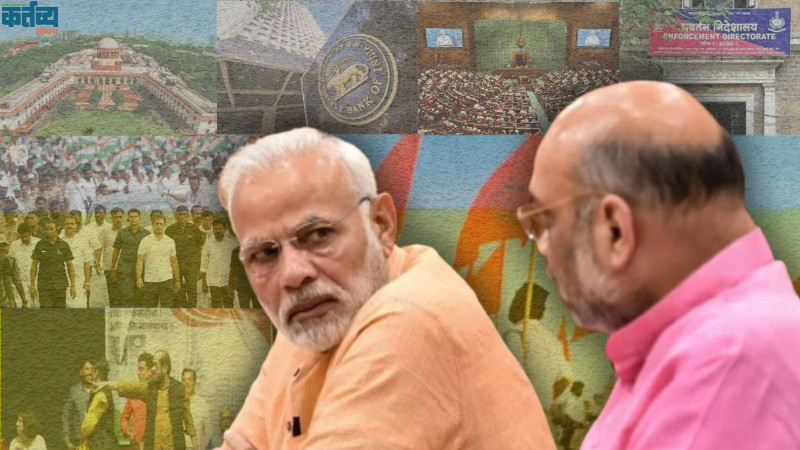
For the next year and a half, I ran the government and the alliance with Lalu’s son Tejashwi as Deputy Chief Minister. But Laluji’s workers and goons once again began to show their true colours, and it started to appear that they were not listening to me either. Seeing the growing distance between us, Modi and Shah cast their net. In fact, barely two and a half years had passed since I had broken away from the BJP. So, neither had Modi and Shah’s anger towards me reduced, nor had mine towards them. However, staying with Laluji’s party was becoming more and more difficult for me with each passing day. Therefore, I rejoined the NDA led by Modi and Shah, and formed a government again with the BJP. Of course, I retained the Chief Minister’s post — that too was a difficult decision, but there was no alternative. One reason was that there was no BJP leader in the state who would trouble me, and with the central government on our side, it would be easier to manage the state’s finances.
So, I left the RJD and the Congress and returned to the BJP in 2017. After that came the 2019 Lok Sabha elections. The BJP got good number of seats, and my party also performed well — we even received ministerial posts at the Centre. A year later we won the Bihar Assembly elections and I became the Chief Minister again. But in about two and a half years, it was clear that the BJP’s ambitions had become excessive. Just as they split the Shiv Sena in Maharashtra, their long-time ally of 25 years, they were carrying out a similar experiment within my party in Bihar. This meant that even after I stayed with Modi and Shah for five years, their desire to take revenge on me had not diminished. Realising this, in 2022 I suddenly went back again with the RJD and the Congress, and made Tejashwi the Deputy Chief Minister once more. For Modi and Shah this was an extremely unexpected jolt. For me too, it was a bitter step to take — but it taught Modi and Shah a lesson. They had never imagined that I would do something like this; they were caught completely off guard. At that time, I told them clearly: if you try to break my party, then what else am I supposed to do?
The second time I came back with Laluji and the Congress, the drums for the 2024 general Lok Sabha elections had already begun to beat. Efforts were underway to form a nationwide front against the BJP. Around two dozen parties came together and the INDIA alliance came into existence. Whenever such an alliance is formed, my name naturally is at the forefront. At that time, some people even began projecting me as a candidate for the post of Prime Minister — it was mainly the media and a few very small parties and organisations that have no real place in electoral politics. But I knew very well that my party is limited to just one state, and even if we win seats in the Lok Sabha, at most we might get 20–25. I am not foolish enough to dream of becoming Prime Minister with the support of a handful of MPs. However, since people continued to take my name, I let them — there was no harm in it. That is why I never said anything about it. At that time, my intention regarding the INDIA alliance was limited. If the BJP became weaker, that is something we wanted — in fact, it was necessary. And if the Congress or other parties formed the government at the Centre, there was no harm for us. Our share in power would increase, and our bargaining power would also grow — that’s all.
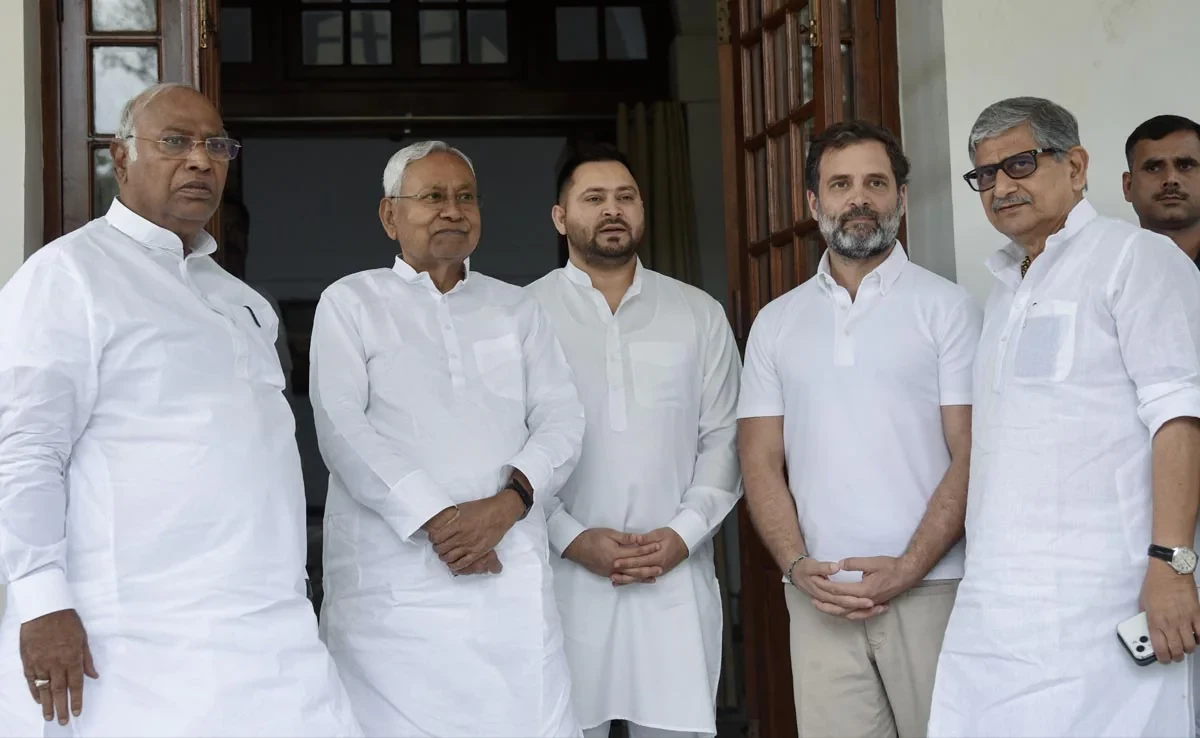 But after the INDIA alliance was formed, the mismanagement of the Congress was visible over and over again. Other parties were bargaining for their own interests, some were playing double games, and the chaos increased. Whether it was a decision regarding the candidate for the Presidential election, or discussing how to allocate seats for the various parties for various state Assembly elections. There were increasing rifts between Rahul and the senior Congress leaders.
Rahul had newly emerged as a ‘messiah’, but the Congress party and organisation had lost its vitality. At the same time, Modi and Shah had begun to feel afraid. Winning the 2024 Lok Sabha election had become a matter of life and death for them. Their confidence had started to shake. Therefore, they began to turn towards me. They pleaded with me, saying: ‘Forget what happened earlier — it will not be repeated.’ They gave me full assurance. At that time, I understood that if I went back to the BJP, the INDIA alliance would become much weaker, and the BJP’s chances of winning the Lok Sabha elections would increase. But if I stayed with the INDIA alliance, what then? There was no guarantee that the BJP would lose power at the Centre. And even if they did, would I be able to win the Bihar Assembly elections that were to come a year later? Even with a big wave, my party would win at most 20 seats in the Lok Sabha — because in seat-sharing, half the seats would go to the RJD and the Congress. With such limited strength, why would anyone make me Prime Minister? And even if a miracle happened, I would end up like Deve Gowda. People are often asked: ‘Would you rather become a Jyoti Basu or Deve Gowda?’ and without a moment’s delay, few of them say they do not want to become another Deve Gowda. I am one of those people. Therefore, I accepted the BJP’s invitation and, while the INDIA alliance was still taking shape in 2024, I left it. At a very crucial and urgent moment, I fulfilled Modi and Shah’s important need, so they must have forgiven my earlier behaviour. Through this, I reassured myself as well as the people of Bihar.
Then the Lok Sabha election happened, and the Modi–Shah government returned to power at the Centre — but with only 240 seats, that is, quite far from a full majority. This gave me the greatest satisfaction, because now that they did not have a full majority, they would need all the NDA allies. Because of this, we fought the current Bihar Assembly election with even greater unity and strength. The BJP are willing to go to any length now, more than ever before. I went along with those ethical and unethical strategies, and in the Bihar Assembly election we received an unprecedented majority. My party won almost as many seats as the BJP, and I took oath as Chief Minister for the tenth time. In the 2029 Lok Sabha elections, things will be even more difficult for Modi and Shah, and since the BJP does not have a majority even now, they will need my party’s MPs for at least the next four years to stay in power at the Centre.
Naturally, for the next four years, they will silently accept my Chief Ministership. They care only about maintaining their power at the Centre, not about Bihar. I, on the other hand, am concerned about Bihar, not about holding on to power at the Centre. I worried about the Centre in 2013, and I had to face consequences. After the 2029 general Lok Sabha elections, the Bihar Assembly elections will take place a year later. At that time, whether the BJP will contest on its own strength or along with me—why think about that question now? So, the point is, if the next five years also go smoothly, then I will be the person who has been in power in Bihar for 25 consecutive years, from 2005 to 2030. Except for the eight nine months of the Manjhi period, I would be the Bihari who has served as Chief Minister for the entire time.
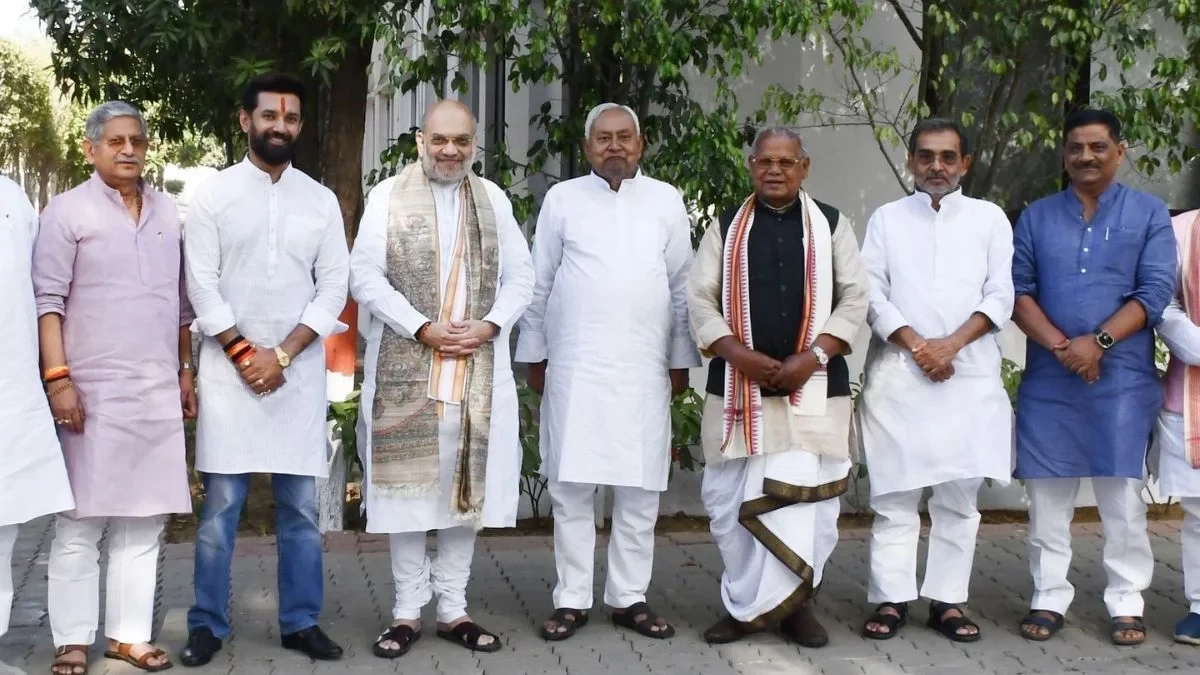 In the past 20 years, under my leadership, Bihar has progressed. Initial ten years, there was Modi’s Gujarat model of development , and here was Bihar’s model of good governance under Nitish. However, in the recent ten years, that model is not recognised by my name. This is because, in this decade I took Lalu Yadav’s party along with me twice — and besides that, the Congress as well. So there was no question of any model. But in the next four–five years, I want to once again rebuild the identity of ‘Good Administrator Nitish Babu.’
At this moment, I am reminded of the twenty years before 2005. In 1985, I became an MLA for the first time, from the Janata Dal. In 1989, in V. P. Singh’s ministry, I became a Minister of State. That government lasted only eight–nine months, but I learned a great deal during that period. At that time, Laluji, Sharad Yadav, Ram Vilas Paswan, and I were the Bihari quartet in the Janata Dal. Later, Laluji took control of the party, Paswan kept shifting here and there. Sharad Yadav and I formed the Samata Party. George Fernandes was our mentor.
Also Read:
आजी-माजी मुख्यमंत्र्यांचे (व्यक्त न झालेले) मनोगत - संपादकीय साप्ताहिक साधना 14 डिसेंबर 2024
उपमुख्यमंत्री क्रमांक 2 यांचे (व्यक्त न झालेले) मनोगत - संपादकीय साप्ताहिक साधना 28 डिसेंबर 2024
During that period, Lalu’s ‘goonda-raj’ spread across Bihar — the situation kept worsening. Our difficulties increased, and it became clear that the Third Front had no real future. The Congress had begun to slide, while the BJP was getting close to the centre of power. Vajpayee had put forward a liberal and inclusive style of leadership. Under the name of the Common Minimum Programme, the BJP was even ready to set aside the controversial issues. We also understood that setting those issues aside was necessary at that time. But in the name of long-term thinking, treating the immediate priorities as secondary does not work in politics. Besides, at the state level we had to directly confront Lalu, and because of that the BJP seemed be the lesser evil. Another reason was that the BJP did not have such a strong position in Bihar at that time, and we did not have the strength to fight alone either. So, considering both the Centre and the State, it was inevitable that we went with the BJP.
From 1995 to 2005, I was mainly at the Centre. During that period, in Vajpayee’s cabinet, I served as the Railway Minister and as the Agriculture Minister. When I was the Railway Minister, a major accident occurred. So, accepting moral responsibility, I resigned from the ministerial post. At that time, many people appreciated this decision, and several even compared me to Lal Bahadur Shastri. While I was Agriculture Minister at the Centre, around the year 2000, I was sent to Bihar to win the Assembly elections and to become Chief Minister. But that Chief Ministership ended within a week. After that, I returned to the Centre and again became the Agriculture Minister. People enjoyed my eloquent speeches in the Lok Sabha. I had earned a reputation as an excellent orator. I was being praised as Vajpayee’s favourite and an efficient minister. Even then, some people used to refer to me as a “future Prime Minister”, and it felt good.
Over the past 40 years, I have been in electoral party politics. The first ten years were in the Janata Dal. The next thirty years were mainly with the BJP. But look at the irony: in these three decades, I am considered to have been favourite of all parties. The only partial exception was the communists, but how many of them are there anyway! Many small and large progressive parties and organisations kept portraying me as a future Prime Minister.
Apart from being nothing more than “Mungerilal ke Hasin Sapne,” it had no real meaning. Even after being with the BJP for such a long period, no one ever saw me as a Hindutva-vadi person — neither the BJP nor any other party. Would that be my greatest ideological achievement? At times I expressed my positions firmly but in gentle words; at times I remained silent. But when I felt Bihar would be harmed, I spoke up. At those times, even the BJP and the Sangh tolerated it. I overlooked many of their small and large incorrect statements and actions.
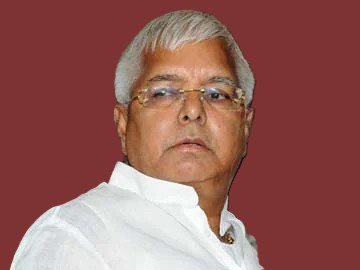 Because throughout this entire journey, the people of Bihar have remained the subject of my love, dedication, pride, and joy. Within the circumstances I faced, I tried to do the best possible for Bihar. It achieved mixed success. We had an understanding that I would not speak against the BJP at the national level, and the BJP’s central leaders would not speak against me in Bihar. Lalu’s “jungle raj” continued in Bihar for fifteen years, and I governed the state in my own way for twenty years. Laluji 's political carrier is near to end , and his son Tejashwi has risen. One day, he will get the Chief Minister’s post. Ram Vilasji’s son Chirag is also young. He too may get some opportunities. Lalu and Ram Vilas were once my colleagues and friends. Their heirs will move forward; my son is not in politics. What will be the future of my party? Someone will rise when I am no longer there. Perhaps, my party may split. Some may go with the BJP, and some may go with Chirag and Tejaswi.
Whatever is destined to happen in the future will happen. But for the next five years, I will take my chance.
I stayed with the BJP for so many years, yet I did not allow a wave of Hindutva to rise in the state. In fact, I thwarted it. Is that not a major achievement? And if that were not the case, would all the progressive and moderate parties have accepted me? In the recent ten years, I have been called a “Palturam.” But I was never going to get power on my own. Then only two options would have remained for the people of Bihar: BJP or Lalu. History will have to acknowledge that I certainly offered a better alternative than both. I have no hesitation in saying that, in the past decade, I became a “Palturam” for the sake of Bihar’s welfare.
Perhaps this will turn out to be my final term as Chief Minister. In all the political ups and downs I have gone through so far, whom do I genuinely want to thank from the bottom of my heart? Who played the most important role in my 20–25 years as Chief Minister? Because of whom did I continue to get the Chief Minister’s post for such a long period? If I mention just one person’s name, you will be surprised. That person is Lalu Prasad Yadav.
Yes, throughout this entire period, Lalu Prasad showed remarkable consistency in opposing the BJP. He committed whatever wrongs he did, but he never aligned with the BJP. He accepted imprisonment, suffered major humiliation, yet he did not bow before the BJP. Had he wished, at any point after 2005 he could have joined hands with the BJP. The BJP would have been ready for it instantly. After 2014, Lalu could even have become a minister at the Centre, and his son could have become the Chief Minister in Bihar. And then I would have been left sitting outside with nothing to do.
Perhaps I might have got a term or two as Chief Minister, but even those would have been partial or incomplete. So, the reason I was able to keep the BJP bending to my terms over the past two decades is precisely because Lalu never bent before the BJP. On the other hand, he formed an alliance with my party twice. Why? As Laluji said, “Nitish is our brother.” This Lalu Yadav, who often appears stubborn and rustic, actually has very firm ideological stand against BJP. It is because of the sacrifices he made that my tenure as Chief Minister became so remarkable. By remaining in the Chief Minister’s post, I was able to do more good for Bihar than anyone else. Therefore, it is not wrong to say that Laluji, through me, contributed to Bihar’s welfare. You may salute me for the commitment to work for Bihari ; I salute Laluji for the comittement to oppose the BJP.
- Editor
kartavyasadhana@gmail.com
(Translated by Rahee Dahake)
Article originally published in Marathi नितीश कुमार यांचे (व्यक्त न झालेले) मनोगत as the Editorial of Weekly Sadhana Issue dated 29-Nov-2025. It will soon be available on https://weeklysadhana.in
Tags: Nitish Kumar Bihar Assembly Elections 2025 Bihar Lalu Prasad Yadav Mahagathbandhan NDA BJP Modi Elections Bihar elections नितीश कुमार बिहार बिहार निवडणूक बिहार विधानसभा निवडणूक 2025 Load More Tags






Add Comment