

All the former editors of Sadhana had larger-than-life personas...They were guides to both readers and society's leaders. I, however, have tried to be an informed and well-read friend to them. To think with empathy from all sides, to encourage others to think likewise, and move towards a clear and decisive stance, has been the core of my personality. Naturally, my approach has been balanced and positive, and I have tried to take principled counter-positions when needed.
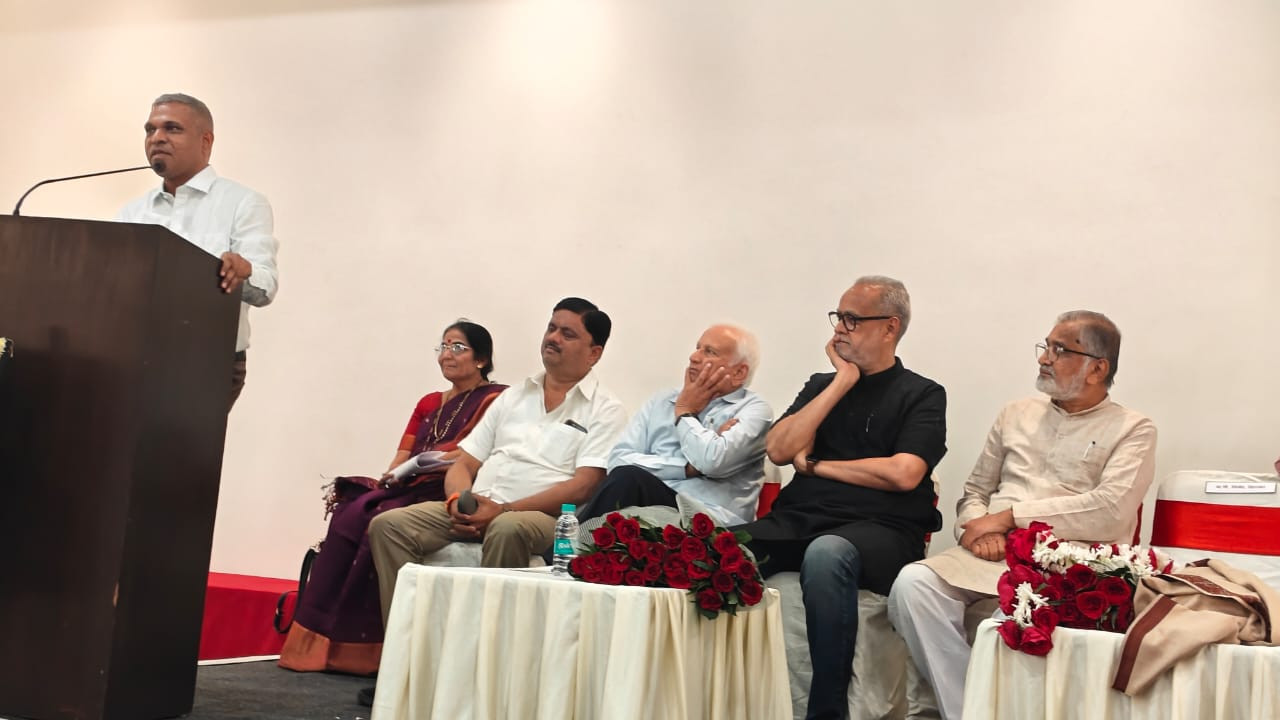
The chairperson of the programme, Dr. Abhay Bang; chief guest Girish Kuber; patron of the award, Girish Gandhi; other dignitaries on the dais, and friends present here, Greetings!
Girish-bhau and I have known each other for the past fifteen years, but in all this time we have met only four or five times, and perhaps spoken on the phone a few times. However, he reads Sadhana regularly, and his association with Sadhana goes back half a century. Naturally, he must know me and Sadhana far better. Therefore, when he informed me over the phone of the decision to give me the Marwadi Foundation’s Prabodhan Award in memory of Prabodhankar Thackeray, what was my spontaneous reaction? I said, “I have certainly done some work of my own. But until now you have given this award to eminent individuals like B. L. Bhole, Pannalal Surana, Sharad Joshi, A. H. Salunkhe, M. M. Gadkari, N. D. Patil, Baba Adhav, Sadanand More, Girish Kuber, Milind Bokil, and others. I do not belong in that league. These people were not just older and more experienced; their reach of work and influence is much larger. Therefore, I cannot accept this award.”
What I said was not merely a gesture of humility. There was some thought behind it. I told him, “I was the chief coordinator for the Maharashtra Foundation’s literature and social work awards for ten years, and I was at the centre of the process of giving more than a hundred awards in that period. I never interfered in the selection committee’s work, but I consistently insisted on one thing: the criteria for the award, and whom it has been given to earlier, must remain central while making the final selection. Because of that, my innate detachment regarding giving and receiving awards has only deepened.”
Even after hearing this, Girish-bhau insisted. So, I said, “If you must give me this award, wait at least another five or seven years.” To this he calmly replied, “I have just recovered from a major illness. Today is the first time I’ve come to the office after five months, and I called you. You have time in your hands, but I do not.” At that, I fell silent. Because no matter how rational I may be, I do understand the value of honest emotion.
So, I agreed to accept the award, but I was restless for the next few days. Later I calmed myself. “This Prabodhan Award is being given to me because I have been doing the work of enlightenment for the past fifteen to twenty years—through Sadhana alone. Through the weekly, the publications, and the various programmes connected to them. Naturally, there are many contributors to this work: former and present colleagues, former and present writers, readers, well-wishers, trustees, advisors. I am accepting this award as a representative of all of them.” Once I explained this to myself, some of my hesitation eased.
My conversation with Girish-bhau happened in early September. But the award was announced in mid-November. My colleagues at Sadhana, family members, relatives, readers, writers and well-wishers were particularly delighted. What surprised me most was that many people felt as if the award had been given to them personally—far more than I had imagined. On behalf of all of them, I thank Girish-bhau, his colleagues, and the Marwadi Foundation. I pay homage to the memory of Prabodhankar Thackeray.
Girish-bhau had told me in early September that the award ceremony would be held towards the end of November. There was enough time. After I agreed, he asked me whom we might invite as guests. I said the guests should be from the fields of journalism or social work. For the next two months, we didn’t speak at all. But in my mind, I had two names I would suggest, if he asked—either of them could be invited. He never asked me. And when the programme was finalized, I realised that he had invited exactly those two people—one as chief guest and the other as the chair. Yet another proof of how well Girish-bhau understands me and Sadhana. Why did these two names come to my mind? Not only do they hold a great influence on contemporary Maharashtra - one of them in journalism, and the other in social work -but also because both of them can look at Sadhana with empathy, and yet with neutrality. And why specifically these two fields? Because journalism is known as the fourth pillar of democracy, and movement-based social work is what I have always considered the fifth pillar. And my belief is that the alliance of the fourth and fifth pillars is necessary to keep a check on the remaining three pillars.
Now I turn to the main subject—Prabodhan which means enlightenment.
Sadhana weekly began on the first anniversary of India’s independence. It was started by Sane Guruji, who can be called the finest Marathi advocate of humanity. Sadhana has been published continuously for the past seventy-five years.
It carries political, social, and cultural writings—mainly analytical and critical. Sadhana has always been known as an ideological and reform-oriented periodical. Acharya Javdekar, Ravsaheb Patwardhan, Yadunath Thatte, Vasant Bapat, G. P. Pradhan, and Dr Narendra Dabholkar—these editors and many others have shaped this identity.
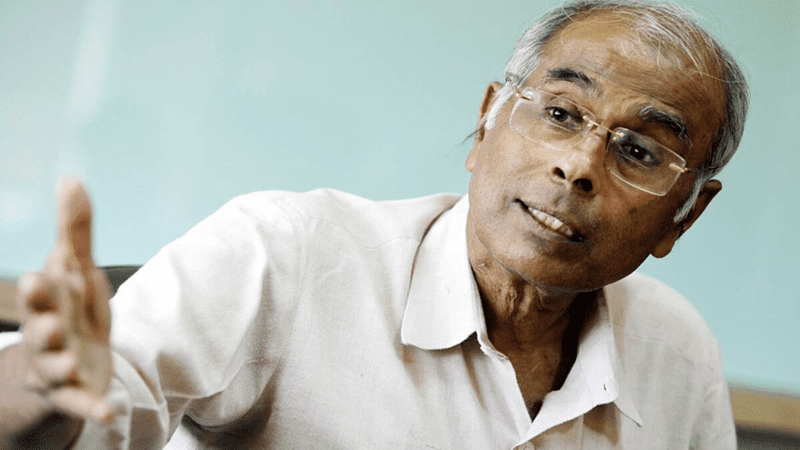
I have been working full-time in Sadhana for the last eighteen years—six years as youth editor and executive editor, and twelve years as editor. Dr Narendra Dabholkar is known as the pioneer of the anti-superstition movement, but for the last fifteen years of his life he was also the editor of Sadhana. I worked with him for nine years. Our first meeting was on 5 January 2004. My first article—an open letter from a young man to Vijay Tendulkar— had been published as the cover story in Sadhana that very week. In that first meeting he told me three things: “The depth and range of your reading is visible in this article. It shows how one can critique sharply with politesse. And your thoughts are moving in the right direction.” That third sentence felt like a big certificate then, and it still feels so today. Because rational thought and rational action were the core of his personality and work. It was a magnanimous testimonial coming from him.
 Sadhana has always had its own readership and its own idealism. Each editor introduced some changes, but the core remained the same. What is that core? Social enlightenment. What kind of enlightenment? In that context, one particular remark is especially important. In 1973, when Sadhana completed twenty-five years, Mukundrao Kirloskar, editor of Manohar magazine, wrote a paragraph. (Back then Manohar was extremely popular among the youth, with circulation above fifty thousand copies, while Sadhana had less than three thousand.) Mukundrao remarked:
Sadhana’s Silver Jubilee: Sadhana weekly has just completed twenty-five years. We congratulate the Sadhana team on this silver jubilee journey. Over the years, Sadhana has taken a few turns here and there, but its main direction has been social enlightenment. In fact, more than enlightening society, it has enlightened society’s leaders. This work is difficult. Measuring its success or failure by circulation alone would be unjust—we shall not do that. In the field of electricity, the generator plays a vital role; in journalism, we believe Sadhana plays that role. The more intellectual electricity it generates, the more light will reach homes through supply stations. That is greatly needed today. We sincerely hope that Sadhana’s thought-generating engine spins faster, fearlessly giving voice to inequality, turmoil, and injustice. And it is our sincere wish that Sadhana is able to show the path toward a new social order, as it envisions. We wish Sadhana success.
—Mukundrao Kirloskar, Manohar, 26 August 1973
Should this comment on Sadhana’s first 25 years be applicable to the Sadhana after that? And the Sadhana of today as well? I do not claim that. But my ideal remains the same, and I have tried to move in that direction—with the help of many.
All the former editors of Sadhana had larger-than-life personas. Their era was different; their challenges and opportunities were different. And naturally, their accomplishments were of a different order as well. They were guides to both readers and leaders. I, however, have tried to be an informed and well-read friend to our readers and society’s leaders. To think with empathy from all sides, to encourage others to think likewise, and then move towards a clear and decisive stance, has been the core of my personality. Naturally, my approach has been balanced and positive, and I have tried to take principled counter-positions when needed. My success has been mixed.
While writing, commissioning writing from others, or choosing pieces to publish, progressiveness has always been a pre-condition. By progressiveness I mean increasingly liberal positions regarding caste, religion, language, region, and gender—and strong opposition to narrow-mindedness in these areas. I have never once wavered on this. However, taking a position on specific topics means facing different ideological groups and social groups. One must endure their anger as openly as relishing their affection. Among these critics are ideological opponents as well as like-minded friends. I can cite many examples, but here are five major ones from my tenure and time:
1. Economic liberalisation has been the key issue of the last three decades. On one side there is blanket opposition; on the other, covert support. Reality and public interest lie somewhere between. Therefore, we consistently argued with varying intensity, that economic reforms and welfare measures are not mutually exclusive. Naturally, we received criticism and praise from both sides.
2. Prime Minister Manmohan Singh had said that Naxalism is the biggest internal security challenge. In that decade, Sadhana consistently took a clear stand against Naxalism. Opinion-makers everywhere believe “their methods are wrong but their goals are right.” We insisted that both their methods and goals are wrong. We faced displeasure from some quarters. And now, under the label “urban Naxal,” what the government is doing is extremely dangerous—it is time to state this firmly.
3. The issue of reservations has continued to smoulder over the past two decades. We consistently supported caste-based reservations and women’s reservations as necessary and the least flawed path. But we also clearly stated that all forms of reservation should be periodically reviewed, and gradually reduced over time. Few opposed us, but not many welcomed this stance either.
4. Regarding reform in the Muslim community, we consistently supported Hamid Dalwai’s path. Many like-minded well-wishers feared this might strengthen Hindutva forces. Ignoring that fear, we clearly advocated Muslim social reform while simultaneously opposing hateful Hindutva and blind and aggressive nationalism.
5. Twelve to thirteen years ago, the agitations of Anna Hazare, Kejriwal, and Baba Ramdev shook the country. We argued then that the country was not on the path to revolution, nor was this a second freedom struggle; instead, the nation would regress. Naturally, the fact that Sadhana, which had always supported social movements and agitations, took such a stance at that time displeased many.
These are only five examples. Many more could be listed. What I can fairly say, from experience, is that taking such positions tests one’s courage and judgement.
During the first of the past two decades, the Centre had a Congress-led UPA government; in the next decade, a BJP-led NDA government. If you read Sadhana issues, specials, articles, and editorials from these two decades, one thing becomes clear: there is sharp criticism of the BJP and similar organisations, but no undue praise for the Congress or similar parties. Because Sadhana’s commitment is to progressive liberal values, not to any political party. Throughout this period, we supported noble ideals and strongly opposed blind and aggressive nationalism.
In spite of doing everything that was possible, there is a long list of what we could not accomplish. In-depth, sustained writing on economics, international politics, industry and trade, and agriculture—Sadhana has not succeeded enough in this. The limitations of the Marathi literary world might be responsible for this, but even so, I strongly feel that we fell short.
Now Sadhana stands at the threshold of eighty years. In the past five or six years, Sadhana has done significant work in the digital sphere. But creativity is essential while using technology, and we have never forgotten that content is the king. Therefore, five years ago, the Independent and Public-Spirited Media Foundation in Bangalore itself came forward to give a grant for the Sadhana Digital Project—their first choice in Marathi was Sadhana. And recently, Oxford University Press, UK, chose Sadhana as the first source to buy digital content for their AI learning. This is further testimony that we are moving in the right direction.
We have always argued that true development requires both qualitative and quantitative growth. If this country is to remain united, modern, and strong, all sections must have equal opportunity—and weaker sections must be given extra support. This is consistent with the values of the Indian Constitution. For that, we must move toward genuine nationalism.
Today and tomorrow, both bring challenges, but the opportunities are greater. To capitalize on those opportunities, every sector needs social leaders. To empower them, the work of enlightenment must continue with all our might. Therefore, efficiency rooted in quality and credibility has always attracted me. If one stays away from temptation, one rarely succumbs to pressure—or develops the strength to resist it. This has been my observation and experience. And if one is internally prepared to pay the price for a well-thought-out position and action, then fighting on the frontlines of enlightenment becomes beautiful and joyful.
Thank you.
- Vinod Shirsath
(Editor, Sadhana Weekly, Prakashan and Kartavya-Sadhana)
editor.sadhana2023@gmail.com
मूळ मराठी भाषण साप्ताहिक साधनाच्या 6 डिसेंबर 2025 च्या अंकात वाचता येईल.
To understand the editor's perspective more comprehensively, do read one of our latest publications -
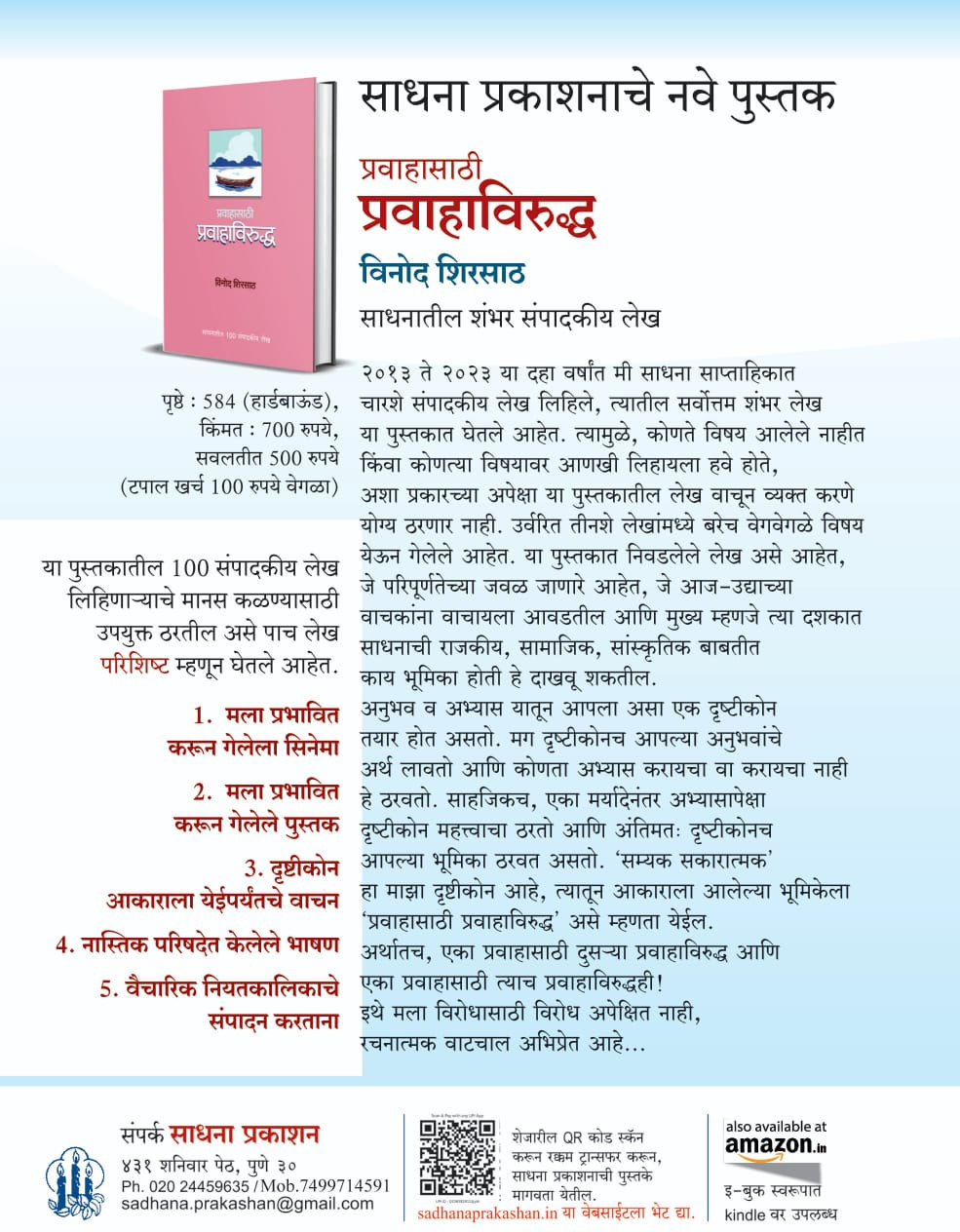
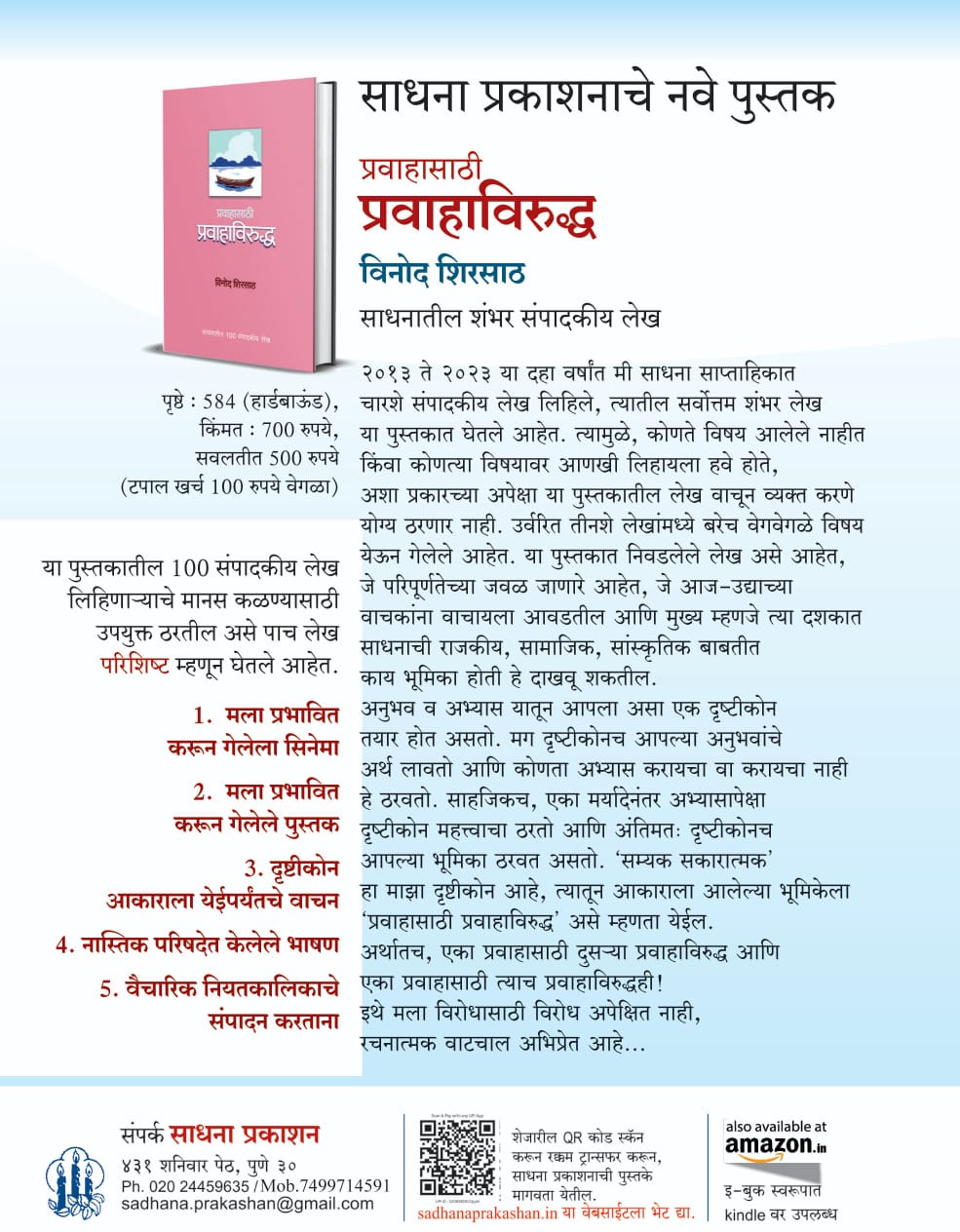
Pravahasathi Pravahaviruddha
A collection of 100 thoughtfully selected editorials by Vinod Shirsath for Sadhana Weekly
"The articles selected in this book come close to perfection. They are engaging for present and future readers and, above all, reflect Sadhana’s political, social, and cultural position during that decade. Experience and study, together shape one’s perspective. Over time, it is this perspective that interprets experience and decides what is worth studying and what is not. Naturally, beyond a point, perspective matters more than study—and ultimately, it is perspective that defines one’s stance. My perspective can be described as Samyak-Sakaratmak (balanced / right / correct / principled and constructive / positive). The stance that emerges from it may be called Pravahasathi Pravahaviruddha “going against the current, for the sake of the current.” That is, opposing one current in favour of another—or even confronting a current, for it's own good. This is not absolute opposition, but my unwavering commitment to constructive movement forward."- Vinod Shirsath
You can buy the book here:
Sadhana Prakashan - Pravahasathi Pravahaviruddha
Amazon - Pravahasathi Pravahaviruddha
Tags: प्रबोधनकार ठाकरे पुरस्कार पुरस्कार समारंभ भाषण नागपूर दिनशे गांधी गिरीश कुबेर प्रबोधन साधना साप्ताहिकातून प्रबोधन राजकीय भूमिका सामाजिक भूमिका ठाम भूमिका Load More Tags




Add Comment