
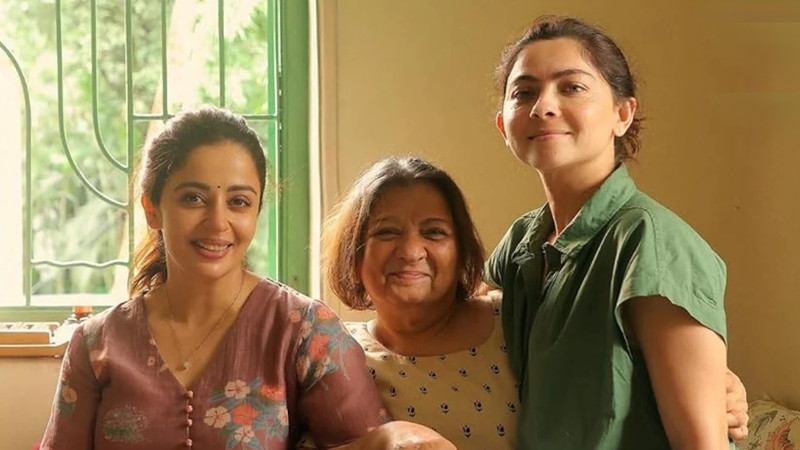
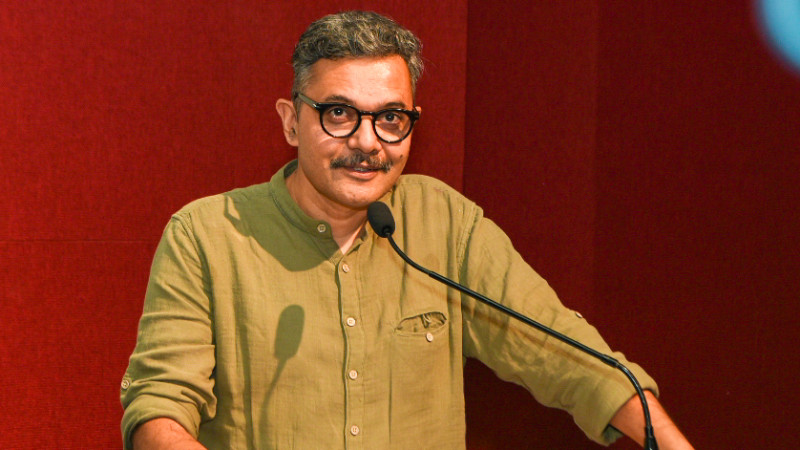
Tighee (Three women), the Marathi film, was released on 6th March 2026. It's directed by debut director Jeejivisha Kale. It's a story of three independent, strong and modern women. A mother in her 70's and her two daughters, the elder, 40 ish, married, and the younger, 30-something, single by choice. They have their own, very private, very personal issues. The mother has cancer. The elder daughter has financial issues, estrangement from her mother and sister, a loving yet aimless husband, and a boss harassing her sexually. The younger daughter is burdened with the responsibilities of running the household and caring for her mother, and is frustrated by having to put her career on hold. And together they have to tackle a big issue, the elephant in the room - a 'dead' father! The film weaves these stories together and shows how one pivotal moment in one life can change many lives forever. It also shows a very subtle and sensitive take on the various forms of harassment and pressure that the modern urban woman has to endure. In this piece, renowned National Award–winning filmmaker Sujay Dahake shares his perspective on the film.
What I liked most about Tighi is that it begins without trying too hard to “be a film.” It just opens on life. The Mumbai stretch with the elder sister Swati immediately feels real — the hustle, the fatigue, the emotional dryness that city life can create. It doesn’t dramatise her struggle in a loud way. It simply places her inside that everyday grind and lets us feel it. That opening is important because it gives the film its base note: this is not going to be a decorative family drama, this is going to be about lived life. And when Swati comes back to her mother’s old house, the whole emotional temperature of the film changes. For me, that house becomes more than just a house. It starts feeling like a womb — protective, old, familiar, slightly suffocating, but still the one place you return to when life has bruised you enough. In that sense, the film is not just about coming back home. It is about coming back to the mother.
The relationship between the two sisters, Swati and Sarika, is one of the strongest parts of the film. It feels observed, not manufactured. We have all seen this dynamic in some form in our homes — the unresolved irritation, the silent love, the old scores, the accumulated guilt, the different ways in which siblings carry the same family wound. The film gets that texture right. Nothing about their equation feels engineered for effect. It feels like these women existed before the camera arrived. That is rare. Very often, sibling relationships in cinema are reduced to neat dramatic oppositions. Here, they remain messy, lived-in and recognisable. That honesty is what holds the film together.
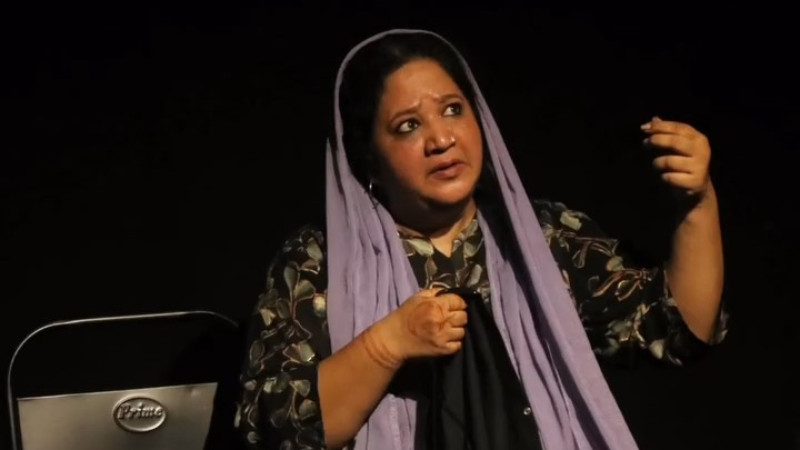
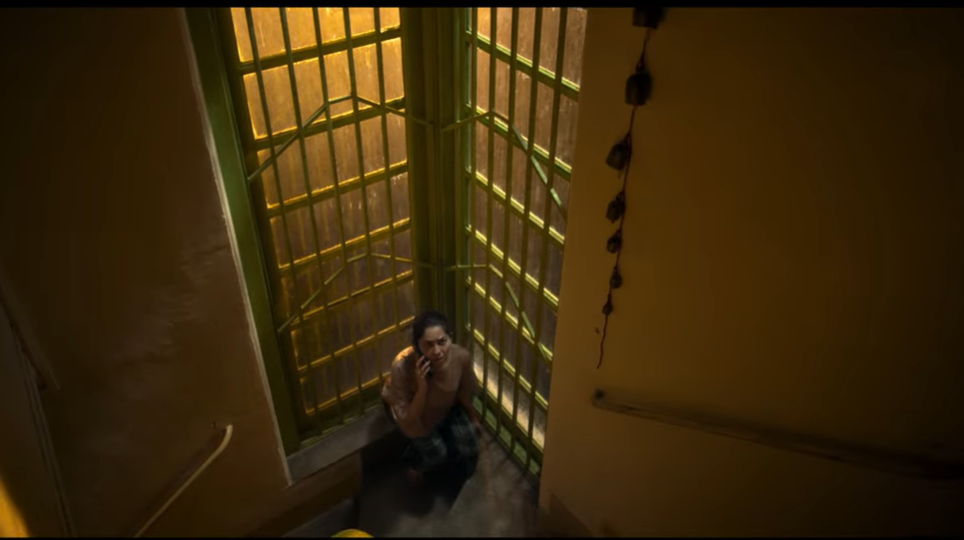 As a director, one thing I pay a lot of attention to is whether a film is trying to perform truth or whether it is comfortable enough to just stay with truth. Tighi belongs to the second category. The performances by Bharti Achrekar, Nehha Pendse and Sonalee Kulkarni are so real that at many places the film stops feeling like fiction and begins to feel like a document of three lives. It’s almost as if the director chose a real house, found a real mother and her two daughters, and decided to quietly observe them. That illusion is not easy to create. It only comes when actors are completely stripped of performance anxiety and when the director knows exactly how much to push and how much to leave untouched. Here, all three women are working from a place of complete emotional truth. Their silences are as convincing as their words.
Another bold choice the film makes is its use of close-ups. The camera stays close for a large part of the film, and that is always a risk. Close-up is merciless. It exposes weak acting, insecure direction, false emotion — instantly. So when a film chooses to live in that space, it tells you two things. One, the director has nerve. Two, the actors are delivering something real enough to sustain that intimacy. In Tighi, the close-ups work beautifully because the film has earned them. The camera is not close for style; it is close because the film wants us to live inside these faces, these hesitations, these swallowed reactions. That kind of visual confidence is not common, especially in a debut.
And that brings me to what is perhaps the most impressive thing about the film: this is an assured debut. Nowhere does it feel like a first-time filmmaker trying to prove herself. There is no nervous over-direction, no show-off craft, no insecurity in tone. The cinematography, editing and sound design all blend seamlessly into the emotional flow of the film. Nothing is screaming for attention, and that is often the biggest sign of command. The craft is not trying to be admired separately; it is simply doing its job and strengthening the emotional architecture of the film. That takes clarity. That takes control. And most importantly, that takes trust in the medium.
What also stayed with me is how observant the film feels. It feels like the director has seen these people somewhere in real life and carried them for a long time. That’s why the film has texture. It doesn’t feel like it was built only from screenplay beats. It feels like it comes from memory, from watching people closely, from understanding how domestic tension actually moves inside a house. This quality is very rare, and it is one of the reasons the film feels so grounded. Observation cannot be faked by technique alone. You either know these people, or you don’t. Tighi clearly knows them.
And finally, the ending. I really admire the courage it takes to end a film where this one ends. It is a brave move. It refuses easy emotional packaging. It trusts the incompleteness of life. And for that, I also want to acknowledge the producers — because standing by a film’s voice, especially at the point where it can so easily be softened or explained away, is not a small thing. It takes conviction.
Tighi is not trying to impress you every ten minutes. It is doing something more difficult. It is trying to stay honest. And because it succeeds at that, it stays with you.
Go watch it in the nearest theatre.
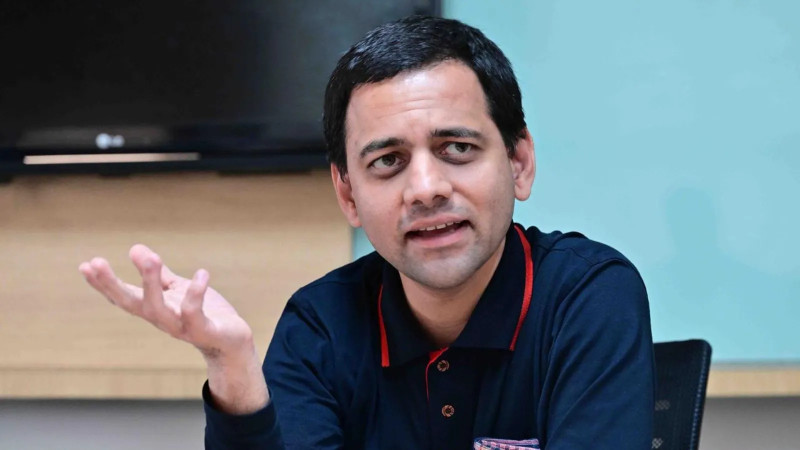
- Suįay Sunil Dahake
Filmmaker
Producers - Nikhil Mahajan, Suhrud Godbole, Swapnil Bhangale, Nehha Pendse Bayas
Director - Jeejivisha Kale
Cast - Bharati Achrekar, Nehha Pendse Bayas, Sonalee Kulkarni, Nipun Dharmadhikari, Pushkaraj Chirputkar, Jaimini Pathak
Screenplay - Nikhil Mahajan
Dialogue - Prajakt Deshmukh
Cinematography - Milind Jog
Editing - Nikhil Mahajan, Hrishikesh Petwe
Music - Advait Nemlekar, Nilesh Moharir
Tags: tighee bharati achrekar sonalee kulkarni neha pendse jeejivisha kale Load More Tags






Add Comment