
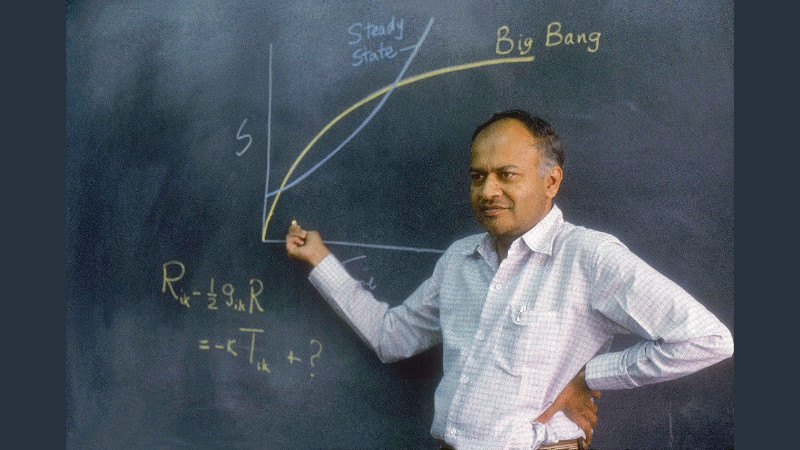
The Big -Bang Universe was supposed to be born about 13.8 billion years ago in a singular event where matter density and spacetime curvatures diverged – became infinite. It was hot big explosion which set the Universe expanding with a very large initial impulsive push. Since then the Universe is continuously expanding; i.e., all the galaxies are running away from each-other.
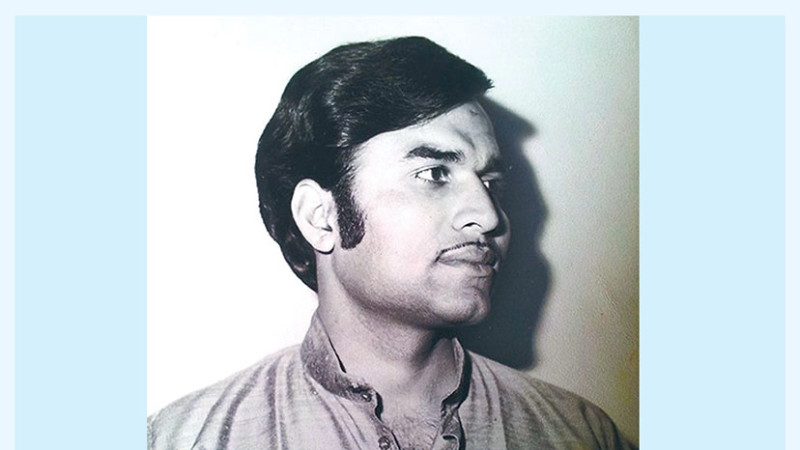
Jayant Narlikar descended on the science canvas of the country not by the usual way but rather by jumping through the roof, when in late 1964, the newspapers headlines splashed with bold caption, a young Indian in collaboration with his mentor, Fred Hoyle, had seen beyond Einstein in their new theory of gravitation. It was presented in the Royal Society in London and had been received enthusiastically the world over.
The independent India, hungry of such a recognition, found a science face and hero in young Narlikar, and that is how he became overnight a household name. It is said that Indira Gandhi, then she was not the Prime Minister, had written to him congratulating on his brilliant discovery, and further adding that her father, who unfortunately passed away a fortnight back, would have been very happy and pleased to hear of your seminal achievement.
Jayant has pursued with great devotion and zeal a continuing discourse with people at large on scientific method, and the enlightening and meaningful role science can play in their lives. His has been the most prominent science voice against astrology, superstitions and blind faith. He was the first and perhaps alone to come out strongly against UGC's proposal of introducing teaching of astrology in universities in the faculty of science. I should mention here for that, he did have to put up with good bit of opposition and discomfort. His commitment to science communication and science education for public at large bears rich evidence in his popular science lectures at all levels and all through the country and abroad, interactions with school children in IUCAA's summer students programme and otherwise, and his popular science and science fiction books at large. He is certainly the man of Nehru's dream for creating a society with scientific temper. The other person who could share the stage of 'public scientist" with him is the ever-affable Yash Pal, who has a charm and way of his own with people. I think we should all be aware of the debt we owe to people at large for their contribution to our comfortable living, and in return it is our bounden duty to participate in science communication in an effective manner so that people are better informed on matters of science and otherwise. This would help them in taking better informed and objective decisions and more importantly to shed off the burden of tradition enforced blind faith and superstition.
It is his commitment to propagation of scientific method and thought among common people that stands him out among his peers. This is also the reason for his universal appeal and popularity.
He was a brilliant student all along and had also made a mark in Cambridge as Fred Hoyle, who was the most sought after Ph.D. supervisor picked him from his illustrious peer group of the likes of Stephen Hawking, Martin Rees, Brandon Carter and George Ellis. He also won the Smith's Medal for research students, and five years later, he shared the prestigious Adams Prize in the august company of Roger Penrose and Stephen Hawking. Penrose was the awarded the Nobel Prize in 2020 for his prediction of black hole.
Much has been known and written about Narlikar’s overall persona but nothing substantial has been written about his science. This is what I intend to do in this article in the simplest form possible. I must say that to discourse on the deep fundamental issues with a lay audience, it is a good measure of how well one understands them. I am on the anvil here, and you have to take it what comes forth with all my limitations of perception and understanding.
His Science
One thing that stands out is that he had always been interested and worked on fundamental problems defying the strong peer group 'bandwagon syndrome' right from his graduate student days in early 1960s at Cambridge. He acquired this trait by osmosis from his legendary guru, Fred Hoyle, who was fiercely independent and enjoyed riding against the bandwagon. But more importantly, like Fred Hoyle, Jayant had a mind of his own and also the courage and conviction to challenge the established view if it did not, in his own assessment, stand the test of independent and dispassionate scrutiny. This is what he had done all through his scientific career. His subsequent professional isolation stems from this unflinching adherence to objective and dispassionate probing of facts and principle.
Now I highlight three of his most important seminal contributions to fundamental physics, astrophysics and cosmology. Let me open out with a pronouncement that many of his ideas were rather too radical for the time when they were propounded but they have subsequently been proven right. Ironically even then, they have often not received due appreciation and recognition for ingenuity, probity and priority. This is rather strange because usually one is lauded for anticipating and predicting the forthcoming ideas and developments. Why has this not happened for him, the answer perhaps lies in the sociology of science to that we will come back in the end.
Hoyle – Narlikar Theory of Gravitation
Mach's principle (MP) for fundamental physicists is a fascinating enigma. Nobody is able to fully comprehend it and to tame it into a clear scientific formulation which could be handled in a quantitative way. The real problem is in its conception, which is poetic and philosophical in form rather than a precise scientific statement. That is why it means different things to different people. Its simplest and broadest statement would be that all particles in the Universe exist through their mutual interaction and they acquire mass or inertia, the essential property of physical existence, through the interaction. That is, a single particle cannot exist.
As it is poetic and aesthetically so appealing and universal in conception, and that is why it becomes irresistible and enticing for any creative mind in general and fundamental physicist in particular. It is therefore no surprise that Einstein also wanted to incorporate it in his theory of gravitation, General Relativity (GR). It didn’t however happen as his theory admits a solution for an isolated single particle.
.png) Fred Hoyle and JayantNaralikar - The Brains Behind The Hoyle-Naralikar Theory Of Gravitation
Fred Hoyle and JayantNaralikar - The Brains Behind The Hoyle-Naralikar Theory Of Gravitation
In early 1960s, driven by the same inspiration as that of Einstein, Hoyle and Narlikar (HN) wanted to construct a theory of gravitation which incorporated MP by writing inertia of a particle as a sum of its interaction with all other particles. Thus was born a new theory of gravitation - HN theory (HNT) which reduces to GR in the limit of many particles. The theory was elegant and mathematically sophisticated, and its most attractive facet was that it addressed the elusive Mach’s principle in an effective scientific way. However, the cosmology it accorded to was the steady state cosmology (SSC) in which the Universe is always in the same steady state with no beginning and no end.
Einstein’s theory of gravitation admitted a solution in which matter in the Universe is homogeneous and isotropic – it is the same everywhere and in all directions, and it is expanding. This expanding Universe solution was found by the Russian scientist, Alexander Friedman in 1924. This was an alternative competing static model constructed by Einstein in 1917 for which he had to introduce the famous cosmological constant in his equation. The model consisted of isolated objects like galaxies which will be pulled together by their own gravity and hence will collapse down to zero size. Some mechanism has to be invented to counterbalance gravitational pull to provide a stable static distribution. The Einstein equation does, however, allow introduction of a constant without changing its physical meaning, and that constant can do the job of resisting gravity. The constant was called the cosmological constant.
With the discovery of Friedman’s expanding model, counterbalance was automatically provided by the expansion, and the cosmological constant was no longer needed. Since then, its inclusion depended on one’s whims and fancy, and Einstein himself seemed to have said that it was his greatest blunder.
It is then imagined that the Universe is born in a singular event where physical parameters like density, temperature etc all diverge -- become infinite. It was termed as the Big-Bang explosive birth of the Universe. This is the Big-Bang theory (BBT) of cosmology. Ironically it was Fred Hoyle, who was the staunchest opponent, had termed it as “Big -Bang” in derision.
In 1948, three friends, Hermann Bondi, Fred Hoyle and Thomas Gold proposed an alternative theory in steady state cosmology (SST) in which Universe appears not only the same in all locations and all directions but also at all times. This is the Perfect Cosmological Principle while BBT was based on the Cosmological Principle in which all locations and directions were indistinguishable statistically at large enough scale, but it was not the same at all times.
Here there were two competing theories and the observations were not sharp enough to definitively decide between the two. Perfect Cosmological Principle and therefore SST had a natural aesthetic appeal as it was free of singular beginning – in it the Universe had always been like this and would ever remain. so. It had no beginning and will have no end.
To settle the issue between the two, BBT and SST, was the prime question in 1950s. And it had to be settled by observations which had to be made sharper and more accurate. It gave great impetus for building new and bigger telescopes. In 1965, came a pathbreaking discovery when the two Bell lab engineers, Arno Penzias and Robert Wilson accidentally discovered an all-pervading radiation coming from all directions. This was the cosmic microwave background radiation (CMBR) and its temperature was, as predicted by BBT earlier, 3 degree Kelvin.
This was the greatest discovery after the Hubble’s expanding Universe. This settled the issue decisively in favour of BBT. One of the SST proponents, Hermann Bondi famously pronounced, it was a beautiful theory, what could one do if the observations did not agree with it.
With this, SST lost the case, and BBT was universally accepted as a valid theory of cosmology. Unfortunately, The same fate also met H-N gravitation theory because it predicted SST cosmology which is not favoured by the observation.
Despite its very attractive feature of the inclusion of Mach’s Principle, which had remained elusive, it lost appeal because the cosmology it accorded to was not consistent with the CMBR observation.
A fundamental theory also gives rise to a paradigm and narrative envisioning the wider and larger canvas of possible phenomena which have to probed and discovered.
The Big -Bang Universe was supposed to be born about 13.8 billion years ago in a singular event where matter density and spacetime curvatures diverged – became infinite. It was hot big explosion which set the Universe expanding with a very large initial impulsive push. Since then the Universe is continuously expanding; i.e., all the galaxies are running away from each-other. This could be envisioned like this – mark the dots on a balloon and blow it up, as it expands every dot on it moves away from every other. Initially when the Universe was created, matter and radiation were bound together, as it expanded, it cooled, at some time, matter and radiation separated. The signature of that event is a freely flowing radiation in all directions bearing a specific temperature which decreases as the Universe expands. Today its value is 3 degree Kelvin (-270 degree Centigrade). This is the cosmic microwave background radiation (CMBR) as mentioned earlier. It is a clear signature of the Big-Band birth of the Universe and thereby BBT.
Action at a Distance Theory
By far the intellectually most satisfying and exciting contribution is Hoyle – Nalikar’s generalization of the famous John Wheeler – Richard Feynman (WF) absorber theory of radiation proposed in 1945. WF developed the Maxwell electrodynamics as action at a distance theory in which it is envisaged that a signal propagates from one charge at some location to the other charge some other location, and that is how electromagnetic interaction is negotiated. This is an alternative to the conventional field theory where field is defined at every point, and charges interact through the agency of field – an imagined very useful and effective construct. Action at a distance approach replaces the field construct be direct action between charged particles.
Maxwell theory, as is well known, is time symmetric and hence admits both advanced (effect preceeds cause) and retarded (cause preceeds effect) solutions. The equation admits both solutions, yet we always observe retarded effect and never advanced. One has to break this symmetry and define an arrow of time. WH did it by invoking thermodynamics, the advanced component was absorbed by the other matter in the Universe and thereby defining an arrow of time.
It is interesting to note that interaction with rest of the Universe as envisaged in Mach's Principle comes again in defining an arrow of time. The natural question then arose how about asking this question in the framework of a gravitational theory that accommodated Mach's Principle. This was what HN did and they argued that expanding Universe in cosmology provided a more natural arrow of time. For that first they had to generalize action at a distance formalism to curved spacetime and then showed that cosmological expansion broke the advanced/retarded symmetry. It was remarkable that the correct result came out only for {\it SST and not for BBT} theory. Action at a distance formulation of Maxwell's electrodynamics in the cosmological setting clearly picked out steady state against big-bang. This is indeed a remarkable result.
The field theory approach is easier to work with and hence became very popular, however action at a distance is more physically appealing as a direct action between particles.
The next challenge was to quantize electrodynamics in this framework. Feynman attempted it but did not succeed and in the process discovered one of the most useful mathematical techniques of path integral formalism which had been so widely used. He thought that since quantization was not possible in action at a distance approach and hence field theory should be preferred over it.
HN also tried their hand at the problem and were able to show that quantum considerations like spontaneous transition of atomic electron, pair production and annihilation, Compton scattering, etc could be handled successfully and adequately in action at a distance framework. They further obtained the most remarkable profound result that response of the Universe constrained various integrals to give finite radiative corrections. Thus, not only WF theory was quantizable and it required {\it no renormalization} (Normalization is an effective technique invented to deal with infinities in quantum field theory. There is no physical justification for it but it works as the experiments have validated all its predictions to a very high degree of accuracy. But it is an open question begging for explanation).
It was the back reaction of the Universe that provided a natural cut-off. This is a very fascinating result by all counts which has not attracted the attention, currency and appreciation, it deserved. It is perhaps because it refers to SST which is not favoured by the cosmological observations.
It is interesting that Hoyle-Narlikar theory we discussed earlier is indeed an action at a distance theory, and they were the first to deal gravity in this framework. In 1968, Jayant also worked out a general correspondence under which a field theory could be replaced by a direct particle theory.
- Naresh Dadhich
nkd@iucaa.in
(Author is a physicist and former Director of IUCAA)
The Marathi Translation Of This Article was published in the Weekly Sadhana issue dated 9th August 2025.
Tags: jayant naralikar iucaa naresh dadhich physics astrophysics big bang theory steady state theory hoyle-naralikar theory sceintific temperament science fiction Load More Tags




















Add Comment