
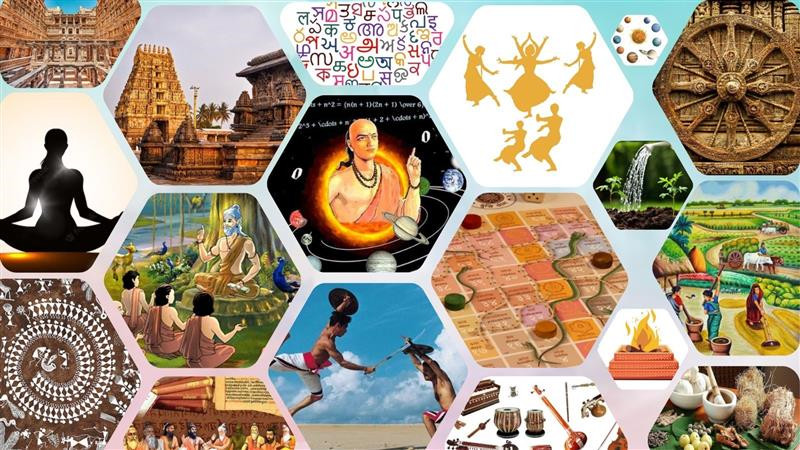
Indian Knowledge Systems is not education. It is nostalgia made compulsory.
Under NEP 2020, the UGC has made it mandatory for every university student in India to take 5% credits in Indian Knowledge Systems. Every B.Tech student, every B.Com student, every Chemistry student must now learn about ‘paramanu’ in Chemistry, Kautilya’s Arthashastra in Commerce, and ‘Ram Rajya’ as a model for Corporate Social Responsibility.
1.5 million teachers are to be trained in IKS
NIRF rankings now reward “contribution to national heritage frameworks.” The question no one wants to answer is simple: What’s the use? Where is this education going to lead in 10 years from now? Let us project it honestly.
In 10 years, will Indian graduates be less employable, or more? How would Global universities judge an Indian transcript with “IKS - Vedic Mathematics - Grade A”? Will we have created a generation that is confident about the past and incompetent about the present? That is not decolonisation. Honestly, that should be called self-sabotage.
This is not a fear for the future. It is already happening.
At IIT-Mandi and IIT-Kanpur, “special sessions” under IKS used flawed EEG protocols to hunt for past-life memories and used astrology to predict engineering outcomes. This is not in a WhatsApp forward. This was reported by science journalist Vasudevan Mukunth as “A Trojan horse has breached the IITs.” At IIT-Delhi, students can now bypass rigorous, mathematically intensive electives by taking IKS courses that evaluate the “metaphysical properties” of traditional materials.
If this is the present, imagine the future.
A Flawed Knowledge System
Basically Indian Knowledge System has been flawed from the start itself. Let us assume, for the sake of argument, that Pushpak Viman really existed.. Let us assume our ancestors really had Vimanas, Brahmastra, plastic surgery, and internet in Mahabharata. Then the most damning question is not “Did we have it?” The question is: Why was the prototype lost in the first place? Because Indians could not build a process/(system) to transfer knowledge.
We had knowledge, but we had no system to preserve it, to test it, to improve it, to pass it on without corruption. Knowledge was locked in a few families, a few castes, a few gurukuls. It was secret, not open. It was memorised, not documented. It was worshipped, not questioned. When the guru died, the knowledge died with him.
Forget Pushpak Viman. Look at architecture. Look at art. Why can we not reproduce the same architecture as before? Why can we not even fix it? We cannot restore the temples of Hampi without UNESCO help. We cannot maintain the stepwells of Gujarat without them collapsing. We cannot rebuild a Kailasa temple at Ellora today - we don’t even have the engineering drawings to understand how it was cut from a single rock top-down. We have lost the process.
A civilisation that cannot preserve and transfer its own knowledge has no right to boast about it. Boasting about a Viman we cannot rebuild is not pride. It is empty ego.
Most of our old knowledge died, not because invaders destroyed it. But because we never built institutions to keep it alive. The British did not kill Nalanda’s knowledge system. We had already killed it by making knowledge the property of a few, not the right of all. And we are repeating the same mistake with IKS today.
We Stand Nowhere In Modern Science!
The defenders of IKS will say: “But we are now publishing so many papers!” Yes. And that proves the point. Between 2020 and 2025, Indian researchers published nearly 1.6 million papers in Scopus-indexed journals - the highest volume in the world. Some private universities recorded over 760% growth in paper output in five years.
But what is the quality? India now ranks third globally in outright retractions. Retraction rate increased from 1.5 per thousand papers in 2012 to 3.5 in 2022. 60% of 3,244 retracted Indian papers were linked to private institutions. This is called the ‘paper fortress’: huge volume, weak citation impact, low patent commercialisation.
In basic research, China now produces 32.6% of the world’s papers. The US produces 18.9%. India produces 7.3%. We are not even half of China. And in citations, which is the real measure of whether anyone actually uses your work, China gets 20.8%, US gets 24.4%, and India is nowhere near.
We cannot produce even half the impactful research any modern country does. Because our system rewards quantity, not curiosity. It rewards copying, not questioning. It rewards publishing, not inventing. What a paradox it is that Indian researchers earn a Nobel when they go out. Because we do not have the infrastructure and support system to harbour knowledge. And now, instead of fixing that, India is constantly cutting down the funding for research and adding IKS credits to distract from it, forcing IKS upon us. What is this - the double standards or hypocrisy of the government?
We are nothing but a useless chimera: a creature that claims to be a lion from the past and a robot from the future, but cannot hunt and cannot compute. It’s half ancient glory, half modern degree, but fully unemployable.
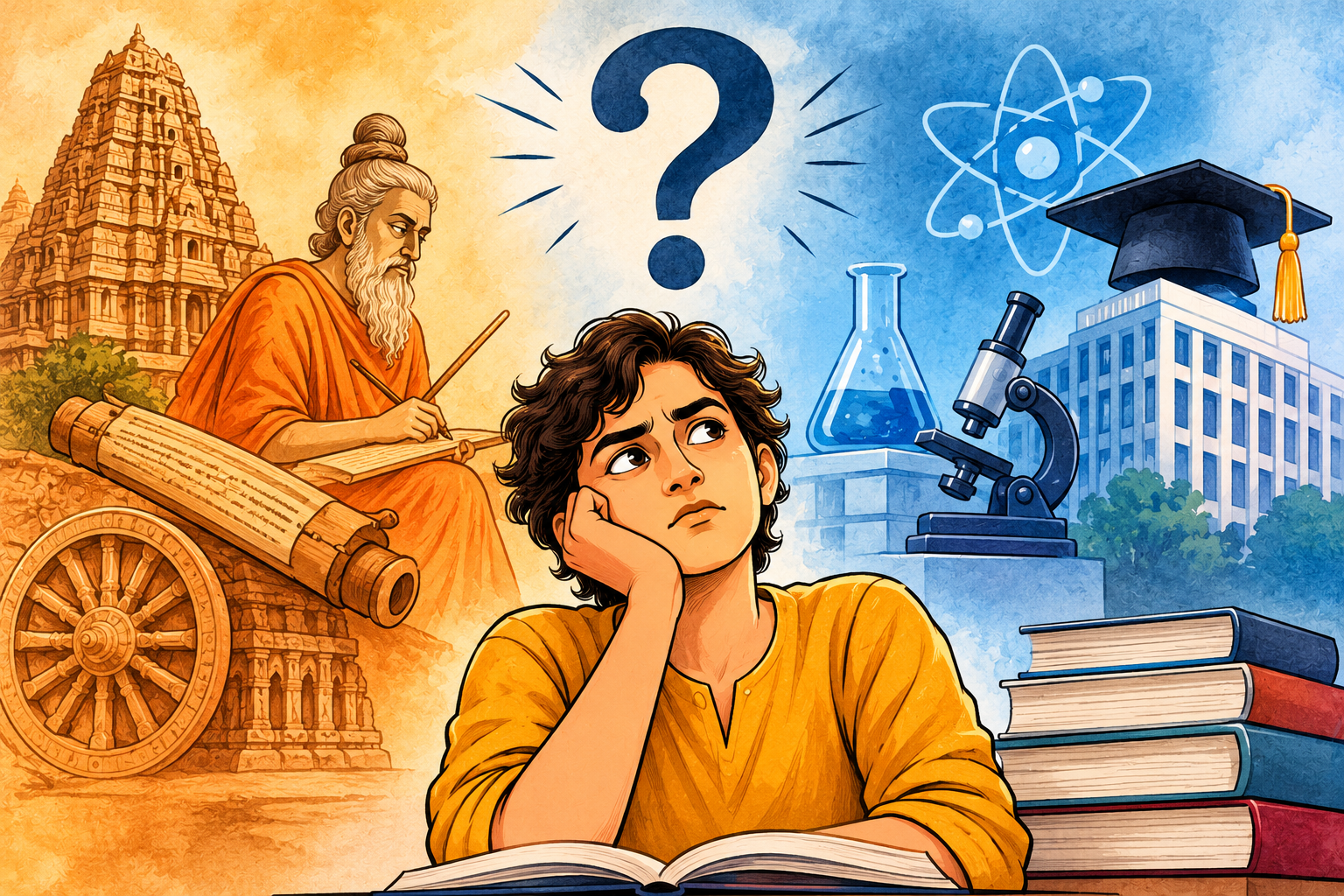 Whose Knowledge? Whose India?
This is the next flaw. IKS is not Indian. It is Brahminical. In fact, it should be renamed as Hindu knowledge system. The UGC framework universalises a single, privileged mode of knowing, predominantly upper-caste Vedic and Sanskritic traditions. It constructs a static and selective portrait of ancient India.
Where is Charvaka - the materialist, atheist school that questioned the Vedas 2,500 years ago? Truth is, Charvaka literature was destroyed before Muslims or colonials invaded India. Because we don't like questions. Because we cannot digest any other thought other than which satisfies us. We are not trained to think retrospectively. Colonials in fact fixed our knowledge system which rewarded rote memorization.
Is there Buddhism in IKS? Where is Jainism? We could not even digest our own Tukaram. Where is Phule? Where is Ambedkar? Where is the Adivasi ecological wisdom that actually saved forests while kings were building temples? There is no place for rationalism. We prefer to kill Dabholkar to listen and spare a thought for him.
Where is Islam? Persian/Arabic works, Ain-i-Akbari, Mughal administration - why are they not regarded as Indians? The knowledge there might be flawed, but it's still worth a thought in studying how various knowledge systems worked. Unani medicine - all erased. Unani is treated as an outsider, Ayurveda as an insider. That is not decolonisation. That is epistemic segregation by religion.
The Wire’s 10-point critique says it best: IKS teaches what to think, not how to think. Kautilya is to be admired, not debated for his caste system and his spy network. ‘Ram Rajya’ is to be praised as CSR, not questioned as a mythical state with no place for Shudras.
If it is truly "Indian Knowledge", why was most of India missing from it? Because it was available in a language which was not accessible to most of the Indians. In fact, still, IKS is taught with the inclusion of Sanskrit shlokas, which is not necessary.
This also violates Article 51A(h) of our Constitution! The duty to develop scientific temper, humanism and spirit of inquiry. Educationists opposing UGC in Karnataka have said it plainly: “This is nothing but an attempt to destroy efforts to build modern education based on systematic research.”
Also Read: Have We Lost Our Way? by P. S. Deodhar
Studying IKS compulsorily is NOT the answer
Let us be clear: We are not saying ancient India had nothing. It had mathematics, astronomy, medicine, grammar, logic. That is worth studying - seriously, deeply, critically. But making every student take this credit compulsory is not the way.
A B.Tech student in Pune who wants to build EV batteries does not need a compulsory credit in Vedic Maths. A nursing student does not need a compulsory credit in Vastu. Forcing them is not education. It is indoctrination. It is wasting their time and our national resources.
The right way is simple. If studying IKS is important, the government should introduce a new, dedicated university - like an Indian Institute of Indian Knowledge - where in-depth research would be possible. Let there be PhDs in Ayurveda, in ancient metallurgy, in Sanskrit grammar, in Buddhist logic. Let them have labs, archives, peer review, international collaboration. Let them prove, with evidence, what was real and what was myth. And most importantly, let them publish in Nature, not in WhatsApp!
That is how you preserve knowledge. Not by forcing a 19-year-old to memorise a shloka for 5 credits and forget it next semester. A dedicated university would do real research. Compulsory credits do fake pride.
From empty ego to Real Pride
Real pride is not in saying “We had Pushpak Viman.” It is building a plane that flies today.
Real pride is not in saying “We had Sushruta.” It is building a hospital where a poor woman does not die in childbirth today.
Real pride is not in forcing IKS on everyone. It is creating a system where knowledge - ancient or modern - is questioned, tested, preserved, and transferred to the next generation without dying or damaging, or corrupting.
Until we build that system, we will remain what we are: a country that boasts about a past it cannot rebuild, and fears a future it cannot build. That is not Indian Knowledge System. That is Indian Ignorance System.
And it is time to say it out loud!
- Snehalata Jadhav
snehalatajj@gmail.com
(The author is a certified Nutritionist and dietician and professor at K.N. Bhise College of Arts and Commerce, Kurduwadi.)
1. Mukunth, Vasudevan. “A Trojan horse has breached the IITs,” _The Wire_, 2025. - On IIT-Mandi / IIT-Kanpur EEG past-life and astrology sessions, and IKS as institutionalised pseudoscience.
2. Rajendran, C.P. & Sabhapandit, Swarati. “Indian knowledge systems need to be inclusive to live up to Constitution's spirit,” _The New Indian Express_, 29 Sep 2025. - On IKS marginalising Charvaka, Buddhism, Jainism, Muslim scholars and violating pluralism.
3. “Ten Reasons Why UGC’s Push for ‘Indian Knowledge’ Is a Threat to Education,” _The Wire_. - On teaching _what_ to think not _how_ to think, Ram Rajya as CSR, erasure of Phule/Ambedkar/Buddha.
4. “Is there any space for Islam in the Indian Knowledge System?” _The Companion_. - On exclusion of Persian/Arabic, Unani, Mughal knowledge from IKS syllabi.
5. NextIAS. “India’s Research Paradox: From Papers to Real-World Impact,” 14 Sep 2026. - On 1.6 million papers 2020-2025, 3rd globally in retractions, ‘paper fortress’, low citation impact.
6. China Fundamental Research Report (2026), reported in _Asia Daily_, 20 Oct 2026. - On China 32.6%, US 18.9%, India 7.3% share of global basic research papers in 2024.
7. UGC Draft Learning Outcome-based Curriculum Framework (LOCF) & NEP 2020 IKS Division Guidelines. - On 5% mandatory IKS credits, NIRF weightage, 1.5 million teacher training.
Tags: indian knowledge system vedic mathematics why iks? iks is useless arthashastra bhumiti maths viman pushpak viman Load More Tags








Add Comment